The iiWii-panel system — a Laminated Stressed Skin Panel combining CLT structural strength with SIP insulation principles — delivers premium buildings up to 60% faster, at 20–30% lower cost, with a verified carbon-negative footprint.
"The iiWii-panel is not a product — it is a complete construction ecosystem: locally sourced, locally built, locally owned."
Certified to European Eurocode and Australian BCA standards. Fire-rated to 1,100°C. Cyclone Category 5 certified. Earthquake resilient.
The same challenges appear on every continent: skills shortages, material scarcity, logistical complexity, spiralling costs, and an environmental debt the industry can no longer ignore. XEO was built to address every single one.
It takes 5–7 years to train a qualified tradesperson. The XEO system uses click-together assembly with standard hardware-store tools — reducing dependence on specialist labour to near zero.
Buildings must meet increasingly strict thermal and energy standards. The iiWii-panel delivers RC values up to 13.80 and U-values as low as 0.18 W/m²K — exceeding even the strictest European requirements.
Concrete and steel construction generates enormous CO₂ and waste. XEO bio-composite structures sequester carbon, generate 27% less construction waste, and are fully recyclable at end of life.
Traditional methods mean sequential phases: design, engineering, site prep, then construction. XEO runs production and site preparation in parallel — saving 50% or more of total project time.
Concrete-heavy construction consumes enormous quantities of freshwater. Bio-composite construction eliminates this dependency entirely, critical for operations in water-stressed regions.
Concrete, clay, and stone buildings emit radon gas — a documented health risk. XEO bio-composite structures produce no radon emissions, providing genuinely healthier indoor environments.
Every technical specification, market analysis, and company document — available directly on this page. Click any title to expand and read, or open in a new tab.
The name stands for "It Is What It Is." The iiWii-panel is an innovative bio-composite building element that combines two proven technologies into one superior system:
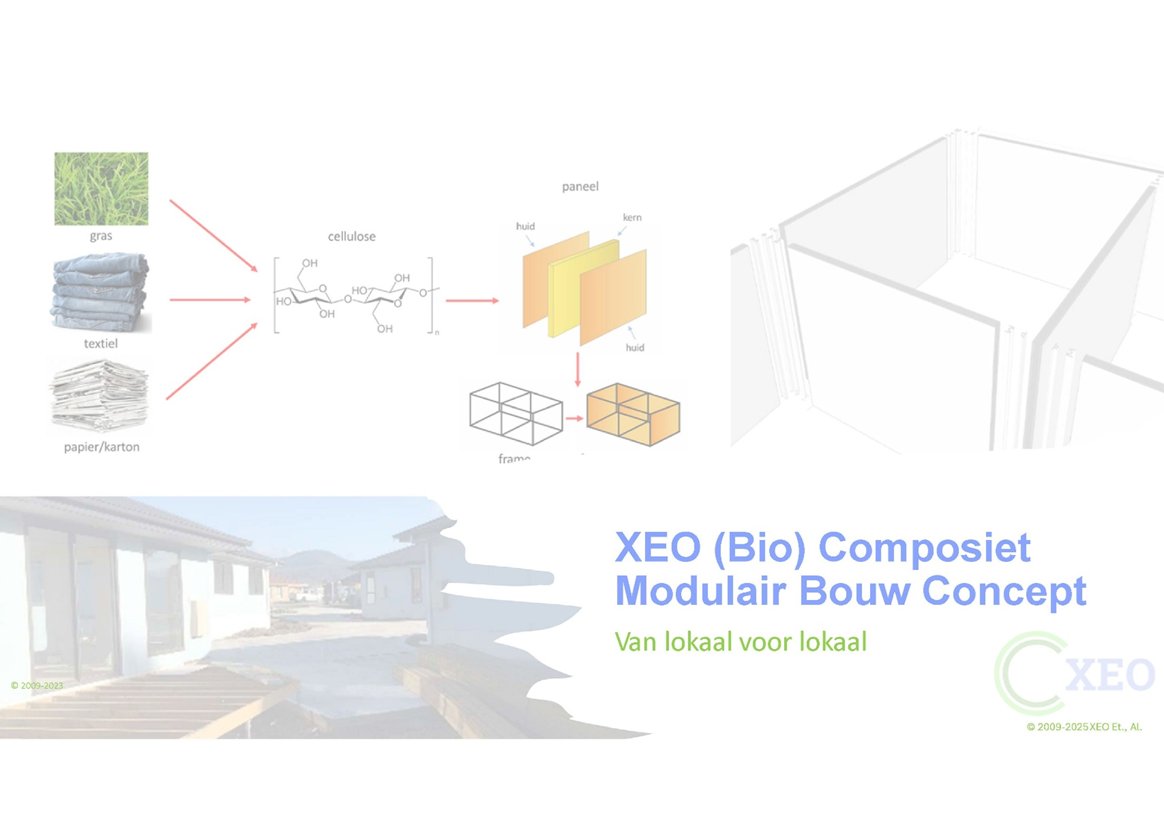
Cross-Laminated Timber (CLT) provides the structural load-bearing framework. Structural Insulated Panel (SIP) principles provide the thermal and acoustic insulation core. Together they form a Laminated Stressed Skin Panel (LSSP) — where the outer "stressed skin" layers carry all structural loads while the inner layer insulates.
Think of it like a tree: the outer bark carries tension and compression forces while protecting the inner core. Nature's own engineering principle, applied to building.
Introduced in Europe by XEO in 2018 — a proprietary formulation allowing panels to be manufactured from any locally available cellulose-rich material: elephant grass, bamboo, rice husk, coconut husk, straw, jeans, cardboard, sawdust. Same structural panel, different raw material source. Local resilience by design.
No grid constraints. Curves, angles, complex rooflines — all buildable. The panels follow your design, not the other way around. Overcomes the rigid-box limitation of most modular systems.
Tested and certified from −50°C to +50°C. Fire resistant to 1,100°C. Certified for Cyclone Category 5. Earthquake-resilient through structural flexibility and lightweight mass.
The engineered cellular panel structure provides sound dampening that exceeds EU standards by 15%. Open-plan spaces that actually sound as designed.
Dramatic reduction in foundation requirements, transport costs, and site equipment. Enables construction in remote locations without heavy machinery. Makes high-rise timber structures viable.
Panels manufactured under controlled factory conditions — consistent quality, no weather delays. Cut and configured on-site to match any design. The best of prefabrication without its limitations.
Unlike steel, which loses structural integrity at high temperatures, large CLT elements form a protective char layer that insulates the inner structure. The panel gets safer as it burns.
Thermal insulation performance by panel thickness. Higher RC values mean better insulation — directly translating to lower energy costs for building users.
| Thickness | RC Rating | Grade |
|---|---|---|
| 90 mm | Entry | |
| 150 mm | Standard | |
| 210 mm | High | |
| 240 mm | High | |
| 300 mm | Premium | |
| 360 mm | Ultra | |
| 450 mm | Arctic |
Full structural, fire, thermal and acoustic compliance. CE marking in progress through TÜV Rheinland and TÜV Nord. Compliant with Eurocode fire test EN 13501 up to 1,100°C.
Meets BCA, AS 1720 (Timber structures), AS/NZS 4859.1 (Thermal insulation), AS 3959 (Bushfire-prone areas), AS 1684 (Timber-framed construction), AS 1530 (Fire tests).
Exceeds requirements. U-values achievable down to 0.18 W/m²K — outperforming most petrochemical insulation systems at standard wall thicknesses.
Engineered cellular structure provides superior sound dampening. Particularly relevant for multi-unit residential, hospitality, and office buildings.
Certified for the highest wind protection level. Earthquake resilience through structural flexibility and low mass-to-strength ratio.
In traditional construction, phases happen sequentially — you cannot start building until the site is prepared. XEO runs panel production and site preparation in parallel, compressing total project duration by 50% or more.
Traditional Construction — Sequential
XEO Modular Construction — Parallel
Panel production runs simultaneously with site preparation — not shown separately for clarity. Note: indicative example; actual savings depend on project scope and site conditions.
Faster construction versus traditional methods. 18-month projects become 7–8 months.
Cost reduction through lower labour requirements and accelerated project timelines.
Reduction in financing costs. Carrying construction loans for half the time changes project economics fundamentally.
Price premium achieved in comparable European markets for sustainably certified buildings.
Engineered wood products — CLT, LVL, GLT, and the XEO LSSP system — are manufactured under controlled conditions that eliminate the natural variability of solid timber while multiplying its structural advantages.
Cross-laminated layers eliminate natural weak points — knots, grain direction variations — creating a material with consistent, predictable load-bearing performance comparable to reinforced concrete at a fraction of the weight.
Traditional wood shrinks, expands, and warps with moisture changes. The layered construction and controlled moisture content of engineered products dramatically minimise these movements — producing structures that stay true over decades.
The flexibility and low mass of engineered wood make it particularly suited to earthquake-prone regions. It absorbs and dissipates vibration energy that would crack or collapse rigid concrete structures.
Paradoxically, large timber elements outperform steel in fire. The outer layers form a protective char layer that insulates the structural core, while steel loses strength rapidly above 400°C and fails without warning.
Every cubic metre of timber in a building stores approximately 1 tonne of CO₂ for the life of the structure. Unlike concrete — which emits massive CO₂ during production — engineered wood buildings are active carbon sinks.
Engineered wood uses wood fibre that would otherwise be waste — offcuts, thinnings, low-grade material — and transforms it into high-performance structural elements. Fewer large old trees, more efficient use of every log.
"The LSSP system is to engineered wood what the carbon fibre monocoque was to automotive engineering — it takes the best properties of the material and structures them to work together, not in isolation."
Lighter than concrete
at equivalent strength
kWh/m²/year
operational energy — 4× below BENG
The raw materials for XEO panels come from waste streams and surplus agricultural flows that would otherwise be burned or discarded. The goal is always local sourcing — adapting the Universal Cellulose formula to whatever is available in the region where you build.
After use, panels can be shredded and returned to natural cellulose cycles. Within normal biological processing time, nature absorbs everything back into new life cycles. No toxic residue. No landfill. No loss.
Embodied CO₂ is negative from day one — cellulose-based panels sequester carbon captured during the growth of the raw material. The building itself is a carbon store, not a carbon debt.
Less construction waste versus traditional building — factory precision means near-zero off-cuts on site
Per m² per year — operational energy consumption that meets the new strict Groningen Energy Norm (01-01-2026). More than four times below the BENG standard, and below the most stringent energy requirement in Europe.
Radon emissions. Zero. No concrete, no clay, no stone — no indoor air quality risk from radioactive gas
Most "sustainable" building materials are less harmful than conventional alternatives. XEO bio-composite materials are genuinely circular — designed from the start to return to nature without residue.
The Cradle to Cradle vision is not a marketing claim — it is an engineering specification. Every material choice is evaluated against two criteria: can it come from a waste stream or renewable source, and can it return to a natural cycle at end of life?
The starting point is circular use: minimum environmental burden, maximum reuse potential. Whether directly reused, reprocessed into new material, or biodegraded — nothing is designed to become waste.
"A baker knows how to make brown bread from whatever locally available ingredients the season provides. We do the same with bio-composite panels — the formula adapts to the local raw materials available, and the result is always structurally sound. Local for local, cradle to cradle."
Raw materials come from the region where the building is located. This eliminates supply chain vulnerability, reduces transport emissions, and creates economic value for local farmers and waste processors.
A local production facility processes the available cellulose streams into panels. The factory model supports 24/5 operation to maximise energy and heat efficiency — and creates stable local employment.
Factory-produced panels, assembled on-site with standard tools. No heavy equipment, smaller crews, weather-independent production. The construction process itself has a minimal environmental footprint.
At end of building life, panels are shredded. Within normal biological processing time, cellulose returns to the earth's nutrient cycles. No toxic residue, no special waste processing, no landfill burden.
The XEO model creates new economic pathways for agricultural and livestock enterprises by turning waste streams into building materials. Farmers gain additional revenue. Communities gain affordable housing. Builders gain a resilient local supply chain.
Collaborating directly with producers of required raw materials. Surplus chopped straw, leftover animal feed, failed harvests, rest crops — materials that currently have near-zero value become a stable, priced input stream for panel production.
Working together means jointly ensuring stability. Revenue models are structured to prevent disproportionate share capture — agreements ensure that no single part of the supply chain dominates at the expense of others. Stable income across the chain.
Collaborating with producers to develop dedicated construction crops — fast-growing, high-cellulose species like elephant grass and Paulownia — that can be grown on marginal land while improving biodiversity and soil quality.
Based on locally available raw materials, develop a joint model that makes it possible to realise affordable homes and buildings with low construction costs — while improving returns for the agriculture and livestock sector involved. Applying crops and construction methods that contribute to solving CO₂, NOx, and Radon challenges alongside the energy transition. Building chains that comply with the highest energy standards — like the Groningen Energy Standard — and going further.
XEO operates as a technology platform and knowledge partner — not a contractor. We bring the IP, the certified system, and the global experience. Partners bring local market knowledge, supply chains, and distribution.
Working together means jointly ensuring stability — stable income, stable supply, and stable quality across the entire value chain. Agreements are structured to prevent that one part of the chain receives a disproportionately larger share than others.
XEO brings a complete ecosystem: proprietary LSSP technology, Universal Cellulose formulation, dual EU/Australian certification, global project experience, and the engineering and strategic knowledge to support local implementation from pilot project to regional production hub.
Joint stability: income remains predictable and consistent over measured periods through framework agreements between all chain participants.
Transparent share structure: agreements prevent disproportionate value capture by any single party — agricultural producers, manufacturers, builders, and investors all benefit proportionally.
Continuous improvement: seek and develop supply solutions together, improving application of available materials over time through shared R&D investment.
Local IP development: the Universal Cellulose formula is adapted regionally, creating locally owned production knowledge that strengthens each partner's position.
Scale together: from pilot project to regional hub — partners grow with the technology rather than being dependent on a distant supplier.
In September 2025, Himperra South Sulawesi — the Association of Housing and Settlement Developers — formally requested XEO as a supply partner for their government-mandated affordable housing programme. The scale is significant.
Himperra is mandated to support the Indonesian government's FLPP (Housing Financing Liquidity Facility) subsidised housing programme — a national target of building three million subsidised housing units. South Sulawesi alone represents 178 developers, each with a target of 1.000 units per year.
Member developers in South Sulawesi alone
Target units per developer per year
Total annual development target — South Sulawesi region
National Indonesian subsidised housing target
Letter of Request — Himperra South Sulawesi, 4 September 2025
To achieve this ambitious goal, we sought a reliable partner capable of supplying wall panel materials in bulk. Using these materials will significantly improve construction efficiency and effectiveness.
We respectfully requested that the materials offered be not only environmentally friendly but also competitively priced to ensure affordability and sustainability. We look forward to the possibility of establishing a mutually beneficial cooperation.
Bachnar B. Abdullah, S.H.
Chairman, Himperra South Sulawesi
Head of CSR
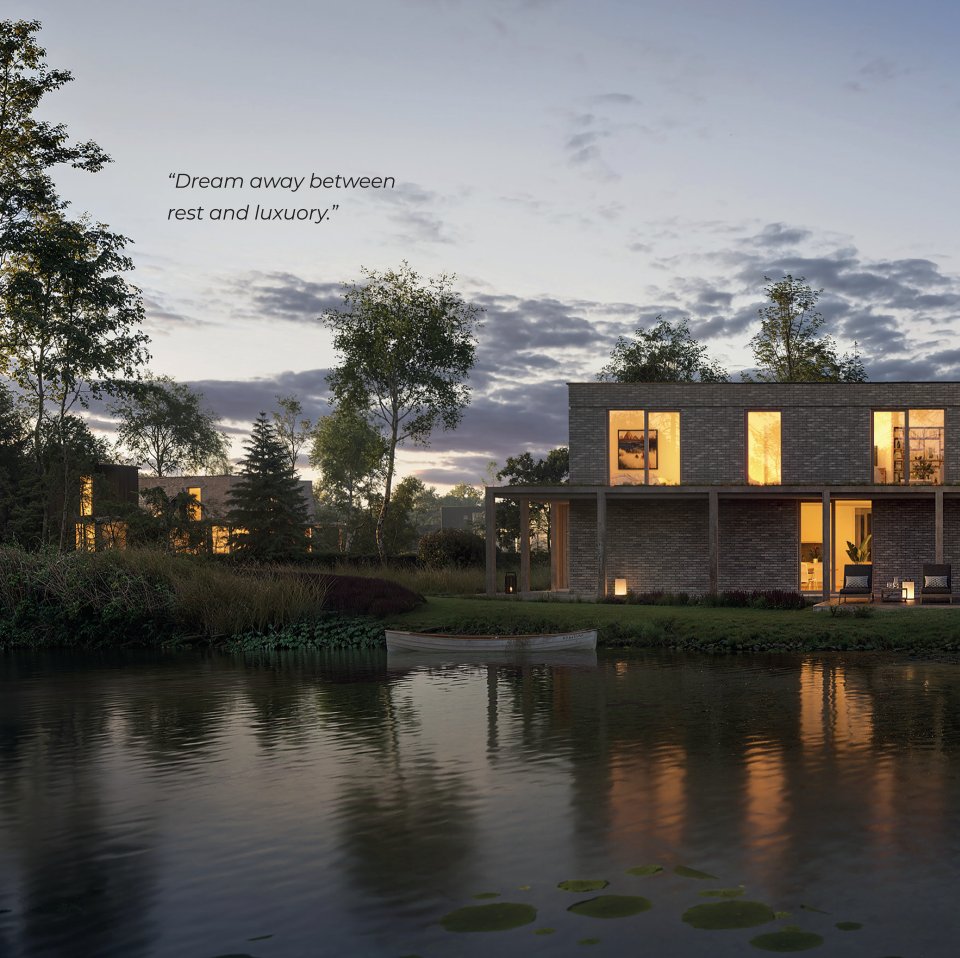
The Heidesee project is a 394-unit premium vacation resort developed using the XEO iiWii-panel system. It is structured as a turn-key investment — the project is acquired by an investor as a completed, operational development built to XEO's certified bio-composite standard.
The iiWii-panel system's design freedom enables resort architecture that would be impossible with conventional modular systems — unique unit typologies, non-linear layouts, and premium material finishes — while capturing all the speed and cost advantages of factory production.
If you are reading this as a prospective buyer of a Heidesee unit — welcome. What you are considering is not a standard holiday property. Each unit is built to a certified bio-composite standard that delivers measurably better thermal performance, air quality, and acoustic comfort than a comparable concrete or timber-frame construction. The carbon footprint of your property is negative from day one.
The resort is structured as a turn-key development: your unit is designed, manufactured, and assembled to a finished standard before handover. No construction delays on your doorstep, no open-ended site costs, no surprises. The iiWii-panel system means that what is specified on paper is what is delivered — factory precision, on-site assembled.
The XEO concept extends beyond structure. The system is designed to support off-grid energy and clean water solutions that address challenges on every continent — particularly relevant for emerging markets and remote locations.
Small electricity pods — compatible with grid charging, car alternators, or purpose-designed solar panels — can store energy for extended periods and act as an in-line buffer for the building. Energy delivery becomes uninterrupted and available when needed, reducing dependency on overloaded national grids.
Water scarcity — green water, blue water, and the growing volume of grey water — is a global challenge. XEO works with proven solutions that can produce drinking-quality fresh water for communities in water-stressed regions, integrated into the modular building concept.
XEO bio-composite construction already complies with the new Groningen Energy Norm taking effect 1 January 2026 — achieving under 15 kWh/m²/year operational energy use. To put that in perspective: the national BENG standard requires under 70 kWh/m²/year. The new Groningen norm is already four times stricter than that. XEO meets it without compromise, positioning bio-composite construction as the reference standard — not the exception.
Certain crops and construction methods simultaneously address multiple environmental challenges. The XEO system contributes to CO₂ sequestration, NOx reduction through reduced heavy transport, and complete elimination of radon emissions — without adding cost or complexity to the building.
XEO's implementation model is designed to minimise risk for all parties: start small, prove the system, build the local supply chain, then scale. Each phase generates returns that fund the next.
A showcase development built with imported XEO components. This gives regulators, contractors, and end-users real-world experience of the system's performance. It establishes local familiarity, accelerates permitting for subsequent projects, and generates the case study evidence needed for broader market adoption.
Establishing relationships with local agricultural and waste-stream producers. The Universal Cellulose formula is adapted to locally available fibre sources. This phase reduces material costs, eliminates import dependency, creates farmer revenue streams, and makes the system economically sovereign for the region.
A local manufacturing facility producing iiWii-panels for multiple projects. Operating 24/5 to optimise energy and heat efficiency. Creating stable employment, building local engineering expertise, and establishing a production capacity that can eventually export panels and knowledge to adjacent regions.
The management structure of XEO embodies the best of international business practice — combining Dutch strategic expertise with local operational excellence. This is not a typical expat-heavy structure that ignores local talent, nor a fully localised operation that compromises international standards.
Nineteen years of hands-on iiWii-panel technology development — not theoretical knowledge, but actual experience from the early Sutee Group days to the current Dutch sophistication. His unique combination of technical innovation and strategic vision is the direct result of personal involvement in every phase of this technology's development.
📍 Haren-Groningen, NetherlandsProven engineering excellence and operational discipline developed through years of practical experience in complex manufacturing environments. His personal competence in managing high-tech production operations in international contexts is directly applicable to each new regional challenge XEO enters.
📍 Ballarat, Victoria, AustraliaCivil engineer bridging Dutch innovation standards and local execution. Responsible for project coordination across the Dutch–international interface, ensuring XEO's quality and compliance standards are maintained throughout each project phase from design through delivery.
📍 International operationsThis structure creates something unique: Dutch quality and innovation standards implemented by management with the personal skills to navigate local market realities, regulations, and culture. The result is operational efficiency that meets international standards while remaining fully compliant with local requirements — made possible only by the combination of person-specific expertise that cannot be replicated by organisational structure alone.
Whether you are an investor evaluating a turn-key project, a developer seeking a construction technology partner, or an organisation exploring the XEO system for your region — we welcome the conversation.
Send an EmailBen Wilmink — Founder & CEO/CTO, XEO Engineered Innovation
Haren-Groningen, Netherlands
Telegram: tjorta · Signal: wilmink.64 · LINE: wilmink
Ross Proud — CTO & Head Engineer (Civil)
Ballarat, Victoria, Australia
Troy Channels — CDO & Project Director (Civil)
International operations